
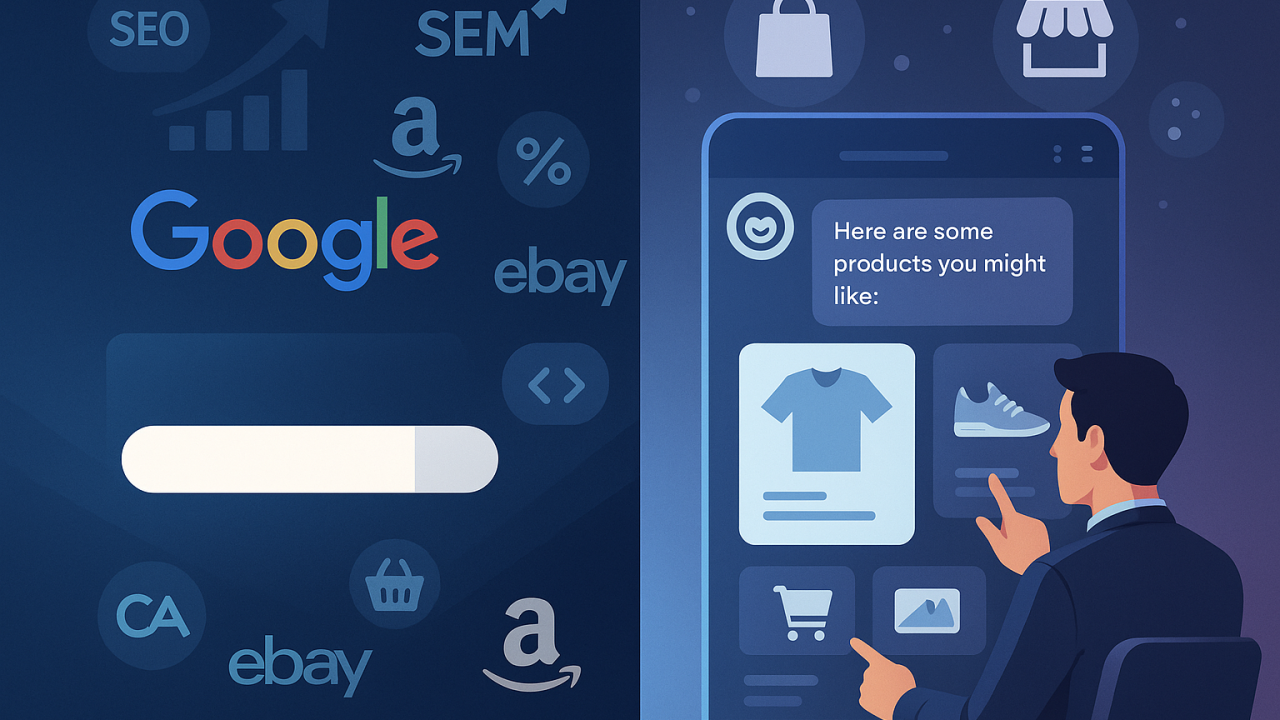
Over the past two years, large language models (LLMs) like ChatGPT have burst onto the scene and rapidly entered mainstream use. It took ChatGPT just months to reach over 100 million users, making it one of the fastest-adopted technologies ever. And it’s not slowing down; as of late 2024, ChatGPT’s website was seeing over 3.7 billion visits per month, and in a single day in May 2025 it handled a record 80 million visits. This explosive growth in conversational AI matters because it is already beginning to reshape how people search for information and products. In a world where customers can ask an AI assistant for anything, the traditional Google search box is no longer the only gateway to discovery.
Why does this topic matter now? Because the way consumers find answers is fundamentally shifting from typing keywords into a search engine and clicking links, to having natural-language dialogues with AI. The implications span across content marketing, SEO, SEM, e-commerce, and distribution strategies. Marketers and business leaders are watching closely.
If user behavior moves from clicks to conversations, companies must adapt how they get discovered online.
From Google to ChatGPT: A Shift in Search Behavior
When ChatGPT launched, many rushed to declare it a potential “Google killer.” The reality so far is more nuanced. Google is still dominant, but user behavior is evolving in notable ways.
ChatGPT for Learning
People increasingly turn to AI chatbots for quick answers, definitions, how-tos and research questions, the kind of top-of-funnel informational queries that used to lead them to blog posts or Wikipedia. Rather than scroll through pages of ads and links for “How does semantic SEO work?” or “Best free tools for content planning,” users can get a direct answer or list from ChatGPT in seconds. In fact, over half (52%) of queries posed to ChatGPT are purely informational in intent (learning or research), compared to about 36% of Google searches. This highlights how ChatGPT has become a go-to assistant for general knowledge questions.
Skipping the Clicks
On Google itself, a majority of searches now end without any click on a result; an estimated 58% of Google searches in 2023 were “zero-click,”meaning the answer was displayed on Google’s page and the user didn’t need to visit an external website.
With AI answers (Google’s Featured Snippets, Knowledge Panels, and the new Search Generative Experiencesummaries) addressing many queries, users often get what they need without clicking through.
And if they go to ChatGPT instead, there’s no link at all, just an answer. This shift poses a challenge for content creators: even if you rank #1 on Google, users might never reach your site if an AI already served up the info.
AI-augmented Search on the Rise
Microsoft’s Bing made headlines by integrating GPT-4 into search in early 2023, offering a chatbot alongside search results. This brought conversational AI into the search workflow, helping Bing gain some ground (especially on desktop PCs) as curious users tried the new experience.
Google responded with its own AI summaries (the Search Generative Experience) in 2024. Even Google’s CEO noted that introducing AI results led to more searches being performed,not fewer; users who get AI-generated overviews tend to ask follow-up questions, increasing engagement.
However, there’s a catch: while search volume grew, click-through rates dropped significantly when AI results were present. One study found that when Google showed an AI snapshot answer, organic results saw a ~70% drop in clicks and even paid ads saw a 12% drop in clicks.
In other words, people kept searching, but they weren’t clicking websites as often, because the AI was feeding them answers directly.
Google Still Reigns (for Now)
Despite the hype, traditional search isn’t dead yet. Recent data shows that into 2025, Google remains the undisputed leader in search traffic.
In fact, Google’s total searches increased about 1–2% from 2023 to 2024, and its site was visited 140 billion times in one month (Jan 2025).
By comparison, ChatGPT’s website saw around 4.7 billion visits that month, a huge number for a newcomer, but still just a few percent of Google’s volume. Moreover, the vast majority of people use ChatGPT as a supplement to, not a replacement for, Google.
In Q4 2024, roughly 21% of U.S. web users tried ChatGPT at least once per month, yet 99.8% of that group also continued using traditional search engines.
In other words, almost no one is onlyon AI; most are using it alongside Google. Traditional search habits are ingrained, especially for complex research, shopping, or when users want to compare multiple sources.
AI tools are currently a complement that handles specific needs (quick answers, coding help, etc.), while Google remains the all-purpose gateway.
So, we’re not witnessing the death of Google, but we are witnessing the birth of a new kind of search experience. For marketers and businesses, the key insight is that discovery is expanding beyond the “10 blue links” model. The top-of-funnel journey is fragmenting: a customer might begin by chatting with an AI, then jump to a trusted website, or skip straight to Amazon, bypassing the once-common step of wading through Google results. This demands a rethinking of how we attract and engage those audiences.
Most queries going to ChatGPT are top-of-funnel informational questions, the same kinds of queries that traditionally led users to search Google and click on content websites. Now, users can ask an AI assistant directly for explanations, recommendations, and how-tos, as shown in the examples above. This shift toward conversational Q&A is changing where early customer engagement happens.
Impact on SEO and Content Marketing Strategy
For content marketers and SEO professionals, the rise of LLM-powered search is a double-edged sword. On one hand, AI chatbots represent a new channel through which people are finding information. On the other hand, that channel often bypasses the traditional content funnel that brands have invested in. Let’s break down the impact.
Top-of-Funnel Content Losing Visibility
Brands have long relied on creating blogs, guides, and explainers to capture people at the “learning” stage of discovery. But now, many users are asking ChatGPT those same questions instead of Googling.
The AI gives them a synthesized answer drawn from various sources, and typically does so without any attribution or link backto the original source.
For example, someone might ask “How do I improve customer onboarding?” and get a detailed answer that was essentially compiled from multiple blog articles, yet the user may never visit or even know about the companies that authored those articles.
The result: even if your SEO is great and you rank well, you might see less traffic, because the AI intermediary is providing the answer.
Zero-Click Searches and AI Snippets
Even on Google Search itself, content marketers are seeing a decline in organic traffic for informational queries. With featured snippets and the new AI-powered summaries (Google’s AI Overviews), Google often answers the question on the search results page, leading to no click-through.
In 2024, these AI summaries appeared most frequently for the very queries content marketers target for awareness(e.g. “what is X?,” “how to do Y”).
Internal Google data indicates informational searches are the most likely to trigger AI answers, and those answers replace the traditional list of website results. In effect, the top-of-funnel content that used to bring new visitors now struggles to even get a click.
One analysis noted: “Brands investing in awareness content need to rethink how they measure success when users are getting answers directly in search results or LLM interfaces.“
The Rise of “Generative Engine Optimization”
Does all this mean SEO is dead? Not quite, but it’s evolving. Forward-thinking marketers are talking about optimizing content not just for Google’s algorithm, but also for AI systems. This has been dubbed “Generative Engine Optimization (GEO)“.
The idea is to structure and craft your content in ways that make it more likely to be cited or utilized by LLMs when they generate answers. That means keeping content high-quality, well-structured, and authoritative, all existing SEO best practices that now carry over to AI.
Clear headings, concise explanations, and schema markup (structured data) can help AI understand and pull your content accurately. For instance, Google’s own advice for its AI Search Generative Experience suggests using FAQ sections and structured dataso that your content might be included in AI-generated overviews.
The challenge, of course, is that even if your information gets used by an AI, you may not get credit. But some AI platforms (like the new ChatGPT browsing mode with citations, or Bing’s chat with references) do provide links. Ensuring your content is seen as a trustworthy source increases the chance that an AI assistant will point users to you.
Focus on Brand and Mentions
In an AI-driven search landscape, brand awareness becomes even more critical. If an AI won’t always send users to your site, you want to at least be mentionedin its answers. Recent marketing commentary suggests it’s “now all about winning the mentions.”
In the era of generative AI, companies need to produce more branded content and get third-party mentions so that their name surfaces in AI responses.
For example, if someone asks ChatGPT for the best project management tools, you hope your product is one of the ones it names in the answer.
Achieving that may require broader content distribution (getting featured in articles, reviews, forums) and strong digital PR, not just traditional SEO. The bottom line for content teams: success is no longer just traffic and clicks, but also brand visibility in an AI-curated world.
So, content marketers should start adjusting KPIs and strategies. Less emphasis on pure traffic metrics for top-funnel content, more emphasis on brand reach and engagement.
Some practical steps include: updating content to address common questions directly (so AI might quote it), adding concise Q&A sections on key pages, and monitoring emerging “AI referral” traffic (ChatGPT now even tags outbound links with utm_source=chatgpt.com for tracking).
The game is expanding from Search Engine Optimization to Search Ecosystem Optimization, optimizing your presence across both human and AI discovery channels.
Impact on SEM and Ad-Driven Traffic
It’s not just organic search that’s feeling the AI tremors; paid search (SEM) is also being affected. Google’s search ads business, which topped $196 billion in 2024, is closely tied to how users search. If fewer people click results or if they bypass Google for certain queries, that could eventually impact ad impressions and spend. What are we seeing so far?
Stable Spend, Shifting Landscape
In the short term, Google’s advertising machine is still churning. In fact, U.S. search ad revenues surged to $102.9 billion in 2024, up significantly year-over-year. Google’s own ad revenue grew about 8% in early 2025, indicating that advertisers haven’t pulled back from search.
Analysts note that “search revenue growth continues to be strong despite worries about generative AI platforms like ChatGPT.“
This suggests that for now, marketers are not abandoning Google Ads, likely because Google is still where the volume and conversions are.
Reduced Ad Visibility for Informational Queries
However, AI answers are starting to chip away at certain categories of searches that are lucrative for ads. Google’s Search Generative Experience, while still in trial phases, pushes traditional ads further down the page when an AI summary appears at the top.
Early data from trials show that when an AI overview is present, paid ad click-through rates can drop by around 12%on those results pages.
Fewer eyes on the ads means fewer clicks. It’s not catastrophic (a 12% dip in CTR, versus the much larger drop in organic clicks), but it’s notable. If AI results expand to more queries, especially high-volume informational queries, advertisers might see less bang for their buck on those impressions.
Shifts in Keyword Value
We may also see shifts in what keywords are worth bidding on. Basic informational keywords (the classic “how to ___” searches)might become less valuable as ad vehicles if users no longer click through for answers.
Meanwhile, highly transactional or local-intent searches (where AI is less likely to fully answer) will remain valuable.
For example, someone asking “ChatGPT, how do I fix a leaky faucet?” might get a full answer and never see the ads a plumber paid for on Google.
But someone searching “emergency plumber near me” will still likely click an ad or local listing. Advertisers are keeping an eye on which keyword segments are dropping in volume or CTR and reallocating budgets accordingly.
Emerging Opportunities in AI Platforms
Interestingly, entirely new ad or partnership opportunities could emerge on AI platforms themselves. While ChatGPT doesn’t currently show traditional ads, we can imagine sponsored results or native recommendations in the future.
OpenAI has announced that ChatGPT’s product search function is not ad-driven, results are chosen independently, but one can foresee a day where brands pay to be recommended, or at least provide their data so they canbe recommended.
For marketers, it’s worth experimenting with these AI platforms now (some brands are creating ChatGPT plugins) to gain early insights.
The landscape for “AI SEO/SEM” will likely evolve, but the constant will be this: wherever users have attention and intent, businesses will seek presence. If ChatGPT commands attention at certain stages, marketers will find ways to insert themselves there, whether via optimization or paid placement.
In summary, search advertising isn’t disappearing overnight…far from it. But the tactics might change. Companies heavy on SEM should monitor metrics on queries that now show AI results: are those seeing fewer impressions or clicks?
It may be wise to diversify budgets, for instance, investing more in product listing ads (which might still show up prominently), or shifting some spend to social and other channels if top-of-funnel search traffic declines.
Google is also likely to adapt its ad products to the new reality, perhaps by integrating ads into AI answers cautiously. In any case, staying agile and data-driven is key as the ground under search advertising shifts gradually toward a more AI-infused model.
Impact on E-Commerce Product Discovery
Perhaps one of the most fascinating shifts is how LLMs might transform the way we discover and shop for products online. Traditionally, a typical product discovery journey might start on Google (“best noise-cancelling headphones”), proceed to a few blogs or retailer sites, and then end up on an e-commerce platform to compare prices (Amazon, etc.). Now, AI assistants are poised to streamline, or upend, that process.
ChatGPT as a Personal Shopper
Some consumers have begun treating ChatGPT like a shopping advisor. You can now ask something like, “I need a gift for a 10-year-old who loves science, under $50. Any ideas?” and get a pretty decent set of suggestions.
In fact, OpenAI recently built a specific product search feature into ChatGPT, recognizing this use case. When a user’s query looks like shopping intent (“best running shoes under $100” or “gift ideas for a baker”), ChatGPT can now return a carousel of product recommendations, complete with brief descriptions and links.
These are not ads, and any merchant’s products can appear as long as the information is available to ChatGPT’s crawler.
The company is even exploring letting merchants submit real-time product feedsto ensure up-to-date listings.
This means in the near future, a customer could have a full product discovery conversation with ChatGPT, “show me more like this… what’s the cheapest option… is there a version in red?” and then be directed to purchase, possibly without ever using a search engine or navigating a traditional e-commerce site menu.
Shopify and Native AI Shopping
It’s not just theoretical. Shopify, a major e-commerce platform, has partnered with OpenAI on an integration that would allow ChatGPT users to browse and even buy Shopify store products directly within the chat interface.
This development is worth special attention: it hints at a future where the conversationreplaces the storefront. Instead of browsing a website’s categories or relying on an Instagram ad, a user might tell an AI exactly what they’re looking for in natural language, and the AI will sift through products to find the best matches.
Crucially, this flips the discovery model to intent-first. As one e-commerce expert put it, “ChatGPT changes the model. It allows discovery to begin with a conversation, and more importantly, with intent.“
In that scenario, what determines if your product gets recommended is not ad spend or catchy content, but how well your product data matches the user’s intent.
The Importance of Structured Data
Given the above, online retailers need to pay close attention to their product data and SEO fundamentals. If an AI is going to recommend your product, it needs to understand your product.
That means having detailed, structured, and machine-readable information about your items. Things like descriptions, specs, pricing, availability, reviews, all should be well-formatted and up to date.
For example, answering a conversational query like “running shoes under $100 that are eco-friendly” requires that the AI can filter products by price and identify which are eco-friendly.
If your product listings don’t clearly indicate those attributes, you’ll be invisible in this context.
Retailers should ensure their websites allow AI crawlers (like OpenAI’s new OAI-SearchBot) to index their content, and use schema markup (i.e. product JSON-LD) to highlight key attributes. Early adopters who feed complete product info to these AI systems could gain an edge in being recommended.
Amazon and the AI Race
No discussion of e-commerce discovery is complete without Amazon, which remains a behemoth. In fact, a majority of US online shoppers (over 60% by some estimates) start their product searches directly on Amazon, bypassing Google altogether.
Amazon is keenly aware of the AI trend and is incorporating generative AI into its own platform. For instance, Amazon’s app recently added an “AI shopping expert“feature that can summarize product details and reviews in a conversational audio clip.
Amazon is essentially building its own AI assistant withinthe shopping experience, allowing users to hear a quick summary instead of reading through specs and comments.
They also introduced tools like AI-generated Shopping Guides and personalized recommendation feed(“Interested in…”) powered by AI.
The goal is to keep the shopper on Amazon by making the search and discovery more interactive and tailored. So while ChatGPT might aspire to become a shopping destination, Amazon is bolstering its defenses by making its vast catalog more accessible via AI-driven dialogs and summaries.
Implications for e-commerce players
Retailers should prepare for a world where product discovery may happen in multiple places: classic search engines, AI chatbots, and traditional marketplaces. Ensuring a strong presence on Amazon and optimizing for its algorithm remains crucial (since many will still go straight there).
At the same time, brands should not ignore the emerging AI channels. If you’re a direct-to-consumer brand on Shopify, you’ll want to be part of the ChatGPT integration. If you have a unique product, maybe create a plugin or API that an AI assistant can tap into. Essentially, make your products “AI-discoverable.”
Just as SEO made your site discoverable to Google’s web crawler, you now must consider discovery by AI crawlers and recommendation engines.
One more angle: this AI-driven search might actually helpniche or new products in some cases. A conversational query allows users to be very specific about their needs (for example, “find me a backpack made of recycled material that fits a 17-inch laptop”).
In a traditional search, a long-tail query like that might not return good results, but an AI could parse it and find exactly the right match if the data is available. This could level the playing field for smaller brands that meet unique customer preferences, iftheir data is thorough and accessible.
In sum, the future of e-commerce discovery will reward those who provide rich information and embrace new discovery platforms, while those who rely solely on one channel (like just Google SEO or just Facebook ads) may find themselves missing out on a growing segment of AI-guided shoppers.
Rethinking Distribution: Will Vendors Go Direct (and is eBay Coming Back)?
Beyond marketing tactics, the rise of AI search raises strategic questions about distribution channels and the relationships between manufacturers, distributors, and marketplaces. As someone who has worked in digital product distribution for over 15 years, I find this particularly intriguing.
In my experience, every shift in how customers find products forces a re-evaluation of go-to-market channels. The AI-driven shift is no different.
Here are a few ways this could play out.
Vendors Going Direct-to-Consumer
If AI assistants start acting as the primary recommender, brands may feel pressure to have a direct presence in those recommendations. In a traditional model, a product manufacturer might rely on distributors or retailers (and their SEO/SEM efforts) to reach customers.
But if an AI is simply suggesting “the best noise-cancelling headphones” based on overall data, the brand that gets mentioned might be the one with strong reputation or direct content about its features.
This could nudge manufacturers to invest more in direct-to-consumer (D2C) marketing and sales, ensuring their brand story and product info is well-represented and easily accessible to AI and consumers alike.
We’ve seen a general trend of brands like Nike reducing their reliance on third-party retailers in favor of D2C channels. The AI search era could accelerate that, as brands seek to owntheir product narrative and not risk being filtered out by an intermediary’s SEO or lack of data.
In short, vendors might increasingly “go direct” so they can control the feed of information that AIs draw from and maintain a direct relationship with customers.
The Role of Distributors and Retailers
Where does this leave the middlemen: the distributors, wholesalers, and multi-brand retailers? They will need to add clear value in an AI-mediated environment.
If a distributor’s site is just one of many carrying the same product info, an AI might not distinguish it for a recommendation unless there’s something unique (like better price, stock availability, or customer service data).
Distributors might lean into providing richer data or content that AIs can use: for example, comprehensive comparison charts, in-depth specs, or aggregated reviews across brands.
They may also need to forge partnerships with AI platforms or marketplaces to ensure their inventory is tapped into.
On the flip side, if more brands go D2C, some distributors could suffer reduced relevance. We might see consolidation, or distributors expanding into direct retail themselves to maintain market presence.
Marketplace Resurgence – The eBay Example
An interesting hypothesis is whether we’ll see a return to prominence of certain marketplaces as a response to AI search. One theory floating around is that platforms like eBaycould make a comeback for product search.
Why? Because on eBay, the factors that determine visibility are straightforward: price and availability.
Shoppers on eBay primarily sort by price, and they can instantly see who has the item in stock and at what cost. In a world where Google’s organic results or AI answers might obscure those details (or favor one result without showing alternatives), some buyers, especially value-conscious ones, might head directly to a marketplace like eBay to ensure they’re seeing all the options.
As AI search experiences funnel people toward a single recommended product or a curated list, the desire to double-check “am I getting the best deal?” could send them to eBay or similar sites where they can easily compare listings.
For sellers, this means having a presence on marketplaces may remain important, even if those marketplaces felt less trendy in recent years compared to direct-to-consumer sites. In fact, I’ve seen cycles in my own career where sellers leave eBay or Amazon seeking higher margins on their own site, only to return when they realize the volume of eyeballs on those big platforms is hard to replace.
If AI-driven search reduces some Google traffic to individual webstores, sellers may once again embrace marketplaces to capture demand.
Stock and Fulfillment Visibility
Related to the above, one thing AI tools currently lack is real-time knowledge of who has an item in stock and can deliver it fastest.
Marketplaces like Amazon and eBay excel at this, showing delivery dates, stock counts, and leveraging vast logistics networks.
Companies heavily reliant on search engine traffic will need to consider how they provide competitive fulfillment info to either the AI (via structured data) or to the user. If, for example, ChatGPT’s recommendation doesn’t include that a product is backordered for 6 weeks, a savvy consumer might still go to Amazon to check availability.
This is where being on a platform that guarantees two-day shipping (Amazon Prime, for example) could sway the purchase, regardless of what the AI initially recommended.
In distribution terms, it means logistics and inventory transparency become marketing advantages. Vendors and retailers might advertise things like “available now, ships tomorrow” more aggressively, or ensure those details are fed into the systems that AI assistants use to make recommendations.
Having navigated numerous shifts in digital distribution (from the rise of Google search, to the social media boom, to Amazon’s domination), I’d say the common thread is adaptability. When buyers moved from physical catalogs to online search, businesses had to master SEO. When the funnel shifted toward Amazon, we learned marketplace optimization. Now, as the pendulum swings toward AI-driven discovery, the lesson is the same: meet your customers where they are gathering. It might be in a chatbox conversation or on a legacy platform revived by new needs…either way, the businesses that experiment and adjust will capture the next generation of customers, while those that stick their head in the sand (“we’ve always gotten our leads from Google, so we always will”) may see diminishing returns.
In practical terms, companies should audit how dependent they are on a single discovery channel. If 70% of your traffic or sales come from Google search today, ask: What happens if, two years from now, half of those searches happen through AI assistants that don’t send clicks?
It’s a scenario worth planning for. That could mean investing more in brand-building (so customers seek you out by name), developing community or content on platforms not reliant on search, or ensuring you’re present on marketplaces and AI discovery tools. In distribution partnerships, it might mean renegotiating terms with vendors or retailers, recognizing that the ones who control the customer interface (be it an AI or marketplace) will wield more power.
Adapting to an AI-Driven Discovery Landscape
The rise of LLM-powered search is not an isolated tech fad: it’s a fundamental change in how people find information and make purchasing decisions. We’ve explored how this shift is altering SEO and content marketing (fewer clicks, need for AI-friendly content), SEM (changing ad value and strategies), e-commerce discovery (new AI shopping assistants and the importance of data), and distribution strategies (potential channel shake-ups and a renewed role for marketplaces). The common theme across all these areas is that user behavior is evolving, and businesses must evolve in response.
What should companies and professionals do to adapt?
Embrace a Multi-Channel Discovery Mindset: Don’t rely solely on Google for traffic. Cultivate presence on emerging AI platforms, traditional search, and marketplaces. Diversify where your customers might find you.
Optimize Content for Humans and AI: Continue creating high-quality, authoritative content (that hasn’t changed…Google still rewards it). But also format that content for easy consumption by AI: use clear structure, schema markup, and include the facts or phrasing an assistant might quote. Essentially, become a source that AI wants to draw from.
Focus on Brand Strength: In a world of fewer clicks, a strong brand can carry you far. If users hear your brand mentioned by an AI or see it in a curated answer, recognition makes them more likely to seek you out. Invest in awareness and reputation so that you’re the recommended answer, not just “one of the many” options.
Leverage AI Tools: Ironically, the same technology changing search can also be your ally. Use AI to enhance your marketing efficiency, for example, to generate variant content, to analyze large datasets of customer queries for insights, or to streamline customer support. Freeing up resources this way can help you focus on strategic adaptation.
Monitor and Experiment: This is a fast-moving space. Keep an eye on analytics: are you getting traffic from chatbots or seeing changes in search patterns? Pilot integrations (like getting your products into ChatGPT’s feed). Talk to your customers about how they find you; you might be surprised that some are already using AI recommendations. Use that feedback to stay ahead of the curve.
Above all, stay curious and open-minded. Just as SEO felt like the wild west in its early days, AI-driven discovery is an evolving frontier. There will be new opportunities for those willing to innovate. As professionals, we should view this less as a threat and more as the next evolution in connecting with our audience.