
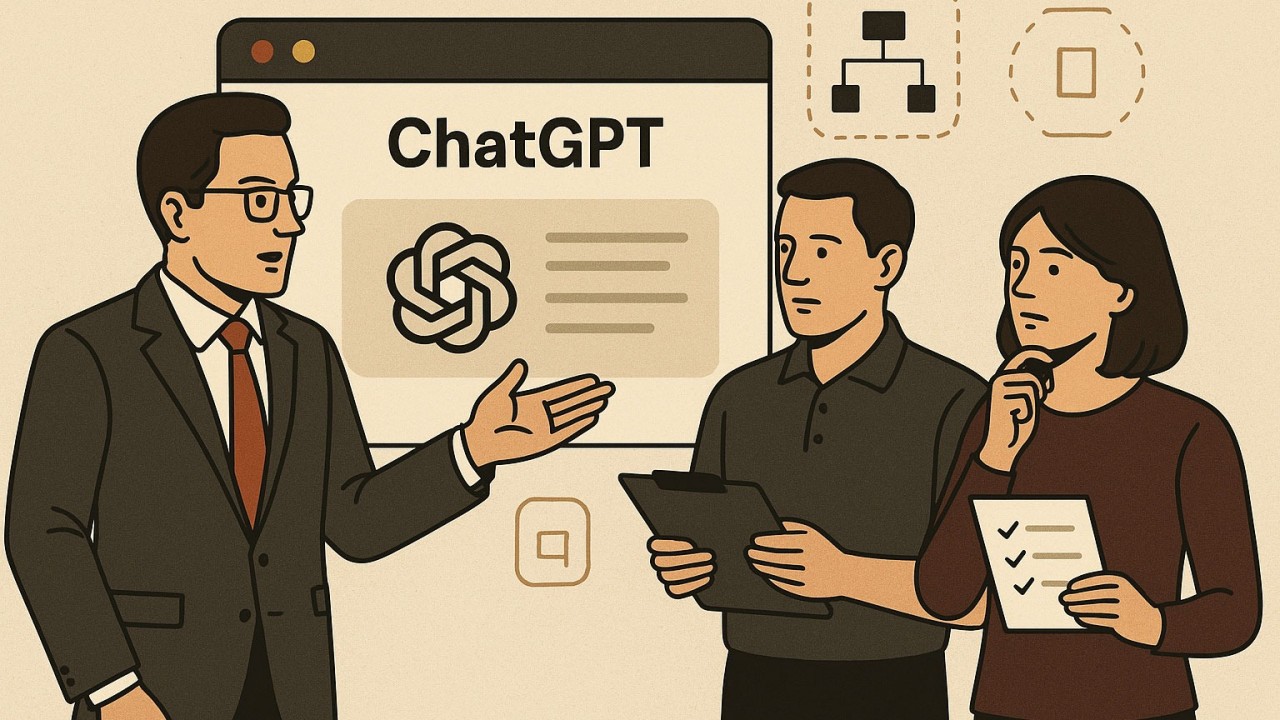
When I started in software development, “quality assurance” often meant the newest developer on the team got saddled with testing someone else’s code. I still remember my first bug-fixing and testing tasks, essentially acting as an unofficial QA, learning the ropes through broken builds and edge-case checklists.
Fast forward to today: I find myself, sometimes acting as a tech lead, asking ChatGPT to generate those very checklists and test cases. The strangest part? As a senior developer, I’ve become the one clarifying requirements and verifying the output, roles traditionally handled by business analysts and QA engineers. It raises a compelling question: have senior developers become the bridge between business and quality, especially as AI tools enter the mix?
A Brief History of QA Evolution
Not so long ago, it was common for junior developers to cut their teeth on QA tasks. Writing unit tests, manually clicking through UIs to find bugs, double-checking feature specs, these were rites of passage for entry-level devs.
Over time, however, agile and DevOps practices introduced a “shift-left” mentality: testing moved earlier in the lifecycle and became a shared responsibility. By the mid-2010s, forward-thinking teams were abandoning the notion of a siloed QA department. In fact, many companies stopped hiring dedicated testers at all, opting instead to have developers own more of the testing process.
This trend was so pronounced that some in the industry provocatively declared the traditional QA role “dead”, noting that developers are now far more involved in testing throughout the lifecycle.
The lines between development, operations, and QA blurred as “everyone is responsible for quality,” integrating QA duties into dev and ops roles .
From my perspective, this was a natural evolution. In one of my earlier teams, we reached a point where no one had the title “QA engineer,” yet quality didn’t suffer.
Instead, our devs (yes, even the junior ones) wrote automated tests from day one and product managers helped define acceptance criteria. We had effectively merged roles: the developers understood the business requirementswell enough to test their own work, and testers (where we had them) coded just as much as they clicked.
This shift-left culture set the stage for what was to come next: AI-assisted development is now pushing the envelope further, transforming how we approach both requirements and testing.
AI Enters the Development and QA Process
Over the past 6 months, generative AI has gone from novelty to normalcy in software teams. It’s astonishing how quickly tools like ChatGPT and GitHub Copilot have become de facto coworkers for developers.
Recent industry surveys show a clear inflection point: 76% of developers are already using or planning to use AI in their development process this year, up from 70% last year, and a GitHub study in late 2024 found 97% of developers had tried AI coding tools at work. Even more telling, nearly half of those who started using AI at work did so in just the last six months, a testament to how rapidly this trend has spread.
What are developers doing with these AI tools? A bit of everything. They’re generating boilerplate code, debugging, writing documentation, and increasingly, creating test cases and scenarios. For example, ChatGPT can suggest edge-case tests that a human might overlook, ask it for additional payment processing test cases and it might immediately list scenarios for declined cards, network timeouts, or invalid promo codes.
This isn’t just hypothetical; engineering teams report tangible benefits. One consulting firm noted that many tech companies saw QA productivity jumps of 25–40%by using ChatGPT to generate test scenarios and review documentation.
On the development side, AI coding assistants are boosting output too. Allpay, a UK payment company, integrated GitHub Copilot and saw developers code faster with a 10% productivity gain and 25% more features delivered to production.
And at BNY Mellon, over 80% of developers rely on Copilot daily to accelerate their workflows. Generative AI, in short, has firmly planted itself into both the “build” and “verify” stages of software work.
On a personal level, I’ve witnessed this shift within my own teams. It’s now common to see a developer pause during a planning meeting and ask ChatGPT to rephrase a confusing requirement, or to generate a quick smoke test suite for a new feature.
The speed is addictive, why spend an hour writing tedious test cases when an AI can produce a decent first draft in seconds? Of course, those drafts aren’t perfect. We’ve had some “AI-generated”tests that missed the mark entirely or code suggestions that didn’t adhere to our architecture.
But even in those cases, the AI at least got the conversation started. It’s like we suddenly hired a dozen enthusiastic junior devs; they work at superhuman speed, but still need oversight and training. And that brings us to the evolving role of the senior developer.
The New Bridge Between Business and QA
As AI takes on more of the grunt work, senior developers find themselves in a curious new position. They are no longer just writing code, they’re orchestrating an ecosystem of humans and AI to get software out the door.
Increasingly, a senior developer is the person who ensures that the business’s needs (often articulated by a business analyst or product manager) are correctly understood by both the team and the AI tools, while also making sure that the AI’s output meets the quality standards traditionally enforced by QA engineers. In essence, senior devs are becoming the bridge between requirements and results.
Consider how the job description has quietly expanded in the last year.
Prompt Engineering for Clarity
Crafting effective prompts for AI tools has become a critical skill. A senior dev might translate a high-level user story into a detailed ChatGPT prompt to flesh out acceptance criteria or edge cases. This requires understanding both the business context and how the AI will interpret the query. In my experience, seniors often act like human-AI interpreters, making sure the business analyst’s vision is correctly conveyed to generative AI in a prompt that yields meaningful output.
AI Output Review and Quality Control
When the AI produces code snippets or test cases, it’s usually the seasoned engineers who perform the review. You can think of ChatGPT as a super-fast junior developer, it writes a lot, not always correctly. Seniors now spend time verifying AI-generated code and test scripts, much like a lead developer would review a junior coder’s work for mistakes or omissions.
AI can draft a test suite or even a functional snippet, but a human must ensure it actually solves the right problem and meets quality standards. As QA professionals will attest, context is king and subtle business logic can be easily missed by an algorithm; thus AI-generated content must be validated by experienced eyes to ensure accuracy.
Business Analysis in the Trenches
Interestingly, I’ve seen senior engineers stepping into quasi-BA roles when working with AI. They will take a vague requirement and interrogate it, sometimes literally chatting with ChatGPT about it, to identify hidden assumptions or ask clarifying questions.
This is something a business analyst would traditionally do, but now the first pass might be an AI conversation. The senior dev curates that conversation: “What if the user input is blank? Did we consider admin users versus regular users?” You can have ChatGPT generate a list of such questions.
By doing so, the senior developer ensures the team fully understands the feature before a line of code is written. It’s a proactive, analysis-driven mindset, using AI to illuminate requirement gaps and ambiguities that might otherwise only be caught late in testing. In effect, the senior dev is channeling their inner business analyst, armed with an AI sidekick.
Mentoring and Governance
Finally, senior devs are also responsible for guiding how the whole team uses these AI tools. This includes setting guidelines (for example, when to trust AI suggestions vs. when to be skeptical) and ensuring ethical, secure use of AI (like not feeding sensitive data into a third-party service). They mentor junior developers not just in writing good code now, but in writing good prompts and reviewing AI outputs critically.
It’s a lot to juggle. The senior developer’s day is now a mix of coding, reviewing, prompt-tuning, and high-level requirement discussion. On paper it might look like more work, but in practice it can allow the team to focus human effort where it matters most.
We free up time by letting AI handle trivial tasks, then reinvest that time into deeper thinking, like refining the product’s user experience or architecting more scalable solutions. In that sense, senior devs are acting as “AI conductors”: they don’t play each instrument themselves, but they make sure the whole symphony sounds good and stays on beat with the business’s needs.
From my own experience, this transition has been both exciting and challenging. Exciting, because we can deliver faster and iterate more when an AI helps generate ideas or catch bugs. Challenging, because it asks senior developers to stretch beyond their traditional comfort zone. I’ve had frank conversations with veteran engineers who admit that writing a prompt feels less “natural” than writing code.
It’s a new literacy to learn. But once they see the payoff, like an AI instantly suggesting a dozen test scenarios we hadn’t thought of, they often come around.
The key is remembering that these tools don’t remove the need for human expertise; they amplify it. The senior dev in 2025 is still the one accountable for the final product’s correctness and viability. They just have a smarter toolkit now to achieve those ends.
Adapting to the New Normal
In a very real sense, the senior software developer role is morphing into a hybrid of architect, business analyst, and QA lead, with AI as a powerful extension of their capabilities. This evolution doesn’t mean junior developers have no place; on the contrary, it means mentorship and learning are more important than ever (someone has to train the next generation of AI-savvy devs, after all).
But it does mean that the seasoned engineers among us are being called to step up and bridge gaps: between high-level business vision and technical implementation, and between automated output and human judgment.
This shift is still ongoing, and it comes with open questions. How do we ensure that critical thinking and creativity don’t get lost if an AI handles the “busy work?” How do we measure a senior developer’s impact when some of their coding is done via AI? And importantly, how do we prepare tomorrow’s developers to thrive in a world where coding and AI collaboration go hand in hand?
One thing is clear: embracing AI in our workflows is not about replacing people, it’s about elevating the people to focus on what humans do best (creative problem solving, complex decision-making) while machines handle repetitive tasks.
As someone who has built and led development teams, I see senior devs rising to this occasion, becoming the linchpins that keep everything aligned. It’s a fascinating time to be in software.