
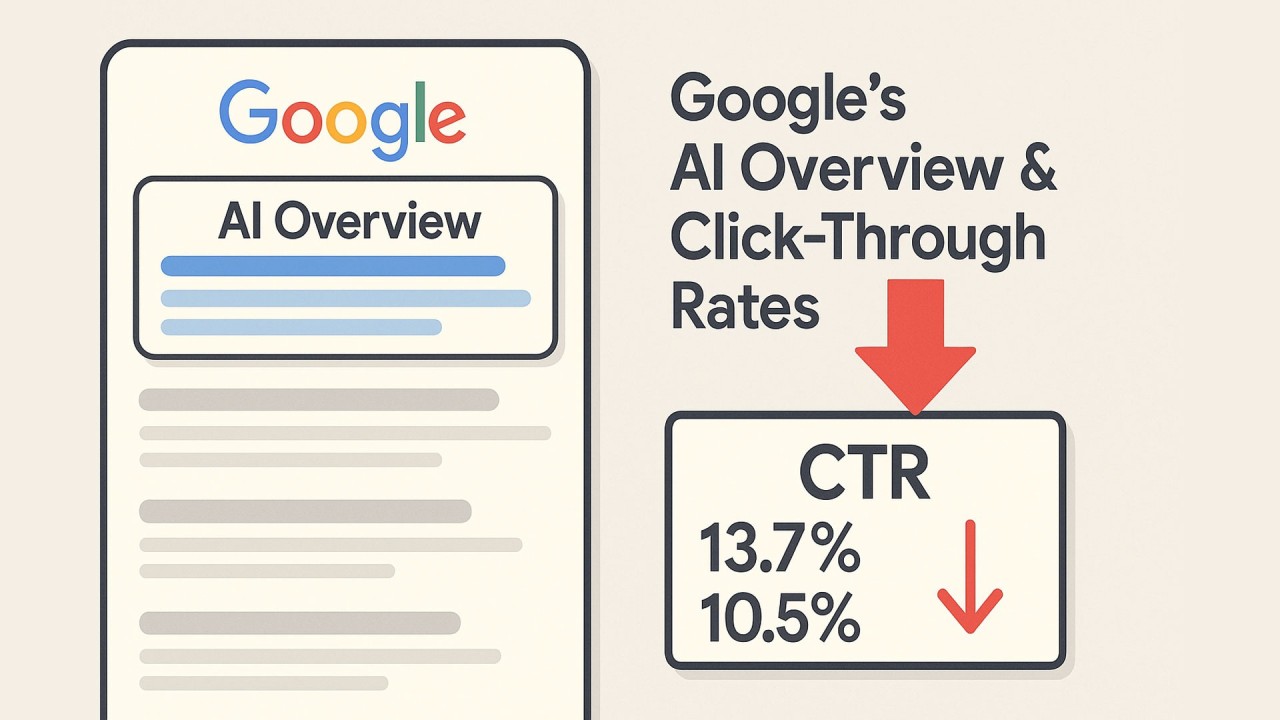
Google’s Search Generative Experience (SGE), an AI-powered summary at the top of search results, is redefining how users interact with search results. Early evidence shows that when Google’s AI Overview appears, fewer users click through to websites, impacting both organic and paid search traffic. This time, we’ll examine recent data on SGE’s impact on click-through rates (CTR) across different query types and industries, and how marketers are responding.
Organic Search CTR Hits Historic Lows
For years, the top organic listing on Google enjoyed a hefty share of clicks (historically around 25–30% CTR for the #1 result). Today, that paradigm is shifting dramatically.
Multiple analyses confirm that organic CTR plummets when SGE is present on the results page. In one study of ~10,000 informational Google queries, overall organic CTR dropped from 1.41% to just 0.64%year-over-year on searches where an AI overview appeared.
Another analysis by digital agency Seer Interactive found a similar pattern: when an AI-generated answer was shown, organic CTR fell by roughly 70%, from about 2.94% down to 0.84%.
This stark decline occurred even though the average organic result rank was similar in both scenarios, meaning it was the presence of the AI answer, not a lower ranking, driving the loss of clicks.
Such findings suggest that users who get an immediate AI-generated answer often bypass the traditional “blue links.” Indeed, early tests indicated organic clicks could shrink by anywhere from 18% up to 64% for publishers once SGE-style answers rolled out.
Now that SGE has been piloted, many SEOs are validating those fears with real data. Some have reported double-digit traffic drops on content-heavy sites since Google introduced AI summaries.
Industry examples are sobering: HubSpot’s extensive marketing blog, for instance, saw an estimated 80% plunge in organic traffic within a year, a drop attributed in large part to Google’s updates and users getting answers from AI results instead of clicking through.
Publishers and informational websites, which often answer the very questions SGE addresses, are feeling the brunt of this shift.
Why the steep drop in clicks? One reason is simply visibility. The AI answer box takes up prime real estate. When SGE appears, it can push traditional results far down the page. In fact, a study by Authoritas found that expanding the AI overview can shove the top organic result down by roughly 1,500 pixels, more than a full screen’s height.
Users often get their answer from the AI text at the top, reducing the incentive to scroll further.
Google’s own data shows that zero-click searches(queries that end without any click) were already nearly 60% of all Google queries in 2024.
SGE is accelerating this zero-click trend by satisfying informational intent directly on the results page.
Paid Search Ads Also See Declining CTR
It’s not just SEO that’s affected, paid search ads are seeing CTR declines as well. Early reports showed that when an AI overview is displayed, users click on ads much less frequently.
Seer Interactive’s analysis of Google Ads data revealed paid ads’ CTR nearly halved from ~21% to 10%if an AI answer was present.
In their dataset, AI overviews and ads only coincided on a small fraction of impressions (~2% in late 2024), but whenever they did, ad engagement dropped substantially.
The likely cause: SGE often “leapfrogs” paid placements, drawing user attention away.
In many cases the AI summary appears at the very top, meaning even the top sponsored link is no longer the first thing users see.
One industry report noted that paid ads now automatically appear lower on the page than they did pre-SGE, and sometimes no ads appear at all above the AI content.
In about 27% of SGE test searches, no traditional text ads were shown alongside the AI result, especially for some informational queries.
When ads do show with SGE, they are often relegated below the AI panel or even to the bottom of the page, prime positions lost, and with them, potential clicks.
Notably, overall paid click-through has been on a downward trend even beyond SGE’s influence. Marketers observed that Google Ads CTR hit 12-month lowsin late 2024, parallel to the rise of AI answers on the SERP.
This suggests evolving user behavior: searchers are less inclined to click ads, possibly due to a combination of growing ad blindness, more rich results on the page, and now AI content satisfying some queries.
Google is well aware of this and has been experimenting with ways to integrate ads into the AI experience.
Google previously previewed new ad formats for SGE, for example, shopping ads or sponsored listings directly embedded within the AI snapshot, so that ads can regain visibility in an AI-dominated interface.
As of early 2025, such formats are not widely rolled out yet, and standard ads are essentially “shoehorned” around SGE content. The immediate effect for advertisers is a hit to performance metrics: fewer impressions and clicks on their search ads when an AI overview steals the spotlight.
It’s worth noting one silver lining for brands: if your content is featured within the AI overview, it can actually bolster your visibility and even your CTR to some extent. Google’s SGE includes source links (citations to websites) in the AI summary. When a brand’s page is among those sources, users may see and click it.
Data suggests that being cited in the AI box lifts the organic CTR for that query; one study saw an increase from about 0.6–0.7% to roughly 1.0% CTRwhen the site was named as an AI source.
Similarly, if a company’s page is highlighted by the AI, any concurrent paid ad from that brand can benefit.
In an analysis of branded queries, paid CTR actually rose from 7.9% to 11%when the brand’s page was featured in the AI suggestions.
These boosts make sense: being referenced in the AI overview gives an implied endorsement and an extra link on the results page. However, this is a small consolation in the broader context; even a doubled CTR in these cases is still a sliver of the original traffic volume, and only a handful of sources get spotlighted by SGE in the first place.
Informational vs. Commercial Queries: Where SGE Hurts Most
SGE doesn’t appear on every Google search; its impact differs by query type and intent.
Informational queries (asking questions, seeking knowledge) are SGE’s prime target.
Google initially deployed SGE for what it called “your most complex questions,” focusing on broad exploratory searches and factual questions.
Data bears this out: Seer Interactive found that question-based queries are far more likely to trigger an AI overview. In their tracking, about 31.6% of queries with an AI result were explicit questions(starting with “what,” “how,” “why,” etc.), compared to only 9.7% of queries that returned a normal SERP without AI.
Additionally, queries leading to SGE were longer on average (around 4.3 words) than those without SGE (3.5 words).
The classic long-tail, informational searches, “How do I improve indoor air quality?” or “What are the benefits of electric cars?,” are precisely where Google’s AI is intervening. These are also the kinds of searches that used to yield multiple content-rich organic results (blog articles, how-tos, guides) which users would click; now the AI summary attempts to answer them immediately, often negating the need to click through.
By contrast, transactional and commercial queries have seen less AI interference initially, but this too is evolving. For example, queries with clear purchase intent (like product searches or “buy/best” queries) do trigger SGE in some cases, but the format may differ.
Google’s SGE can provide product comparisons or summaries, and we still see Shopping ads or product listings featured prominently for these queries. Research by SERanking noted that ecommerce-related searches often show shopping ads even alongside SGE(sometimes above the AI panel).
In fact, Google appears cautious about fully replacing certain high-commercial intent results with AI. SGE was observed less frequently for queries in sectors like insurance, finance, or jobs; in tests, those verticals sometimes didn’t display any ads with SGE results, possibly because many such queries are answered by the AI or because Google hasn’t integrated relevant ads yet.
Still, even if SGE currently focuses on informational intents, the lines are blurring. Google has been expanding SGE’s coverage steadily. One longitudinal study found that SGE coverage for a set of finance-related queries jumped from 22% in mid-2023 to 47% by April 2024, indicating Google’s AI answers are encroaching on ever more query types as the system improves.
Google is effectively training SGE on more commercial and sensitive topics over time (even health and finance, which are “Your Money or Your Life” topics, see significant AI answer rates).
The implication for CTR is that sectors that were initially “safe” from SGE may soon feel the impact as coverage widens.
Not all industries are feeling the squeeze equally: the impact varies by vertical. AI overviews appear far more for some categories of searches than others. According to a SearchEngineJournal study, health and wellness queries are an outlier: about 68% of tested health queries showed an automatic SGE result(with no user prompt needed).
Other information-heavy verticals like education, how-to DIY, and general knowledge queries also have high SGE presence. One report noted that “verticals like Health, Beauty, and Publishers see AI answers frequently, whereas areas like Hotels and Entertainment see AI far less often.”
In that analysis, travel and hospitality queries had SGE appear only ~4–6% of the time by default.
These differences suggest that sectors centered on factual content are more heavily impacted by AI summaries than sectors centered on experiential or local decisions (i.e. entertainment or hotels, where users might still prefer to browse listings and reviews).
However, as SGE expands, even those currently less-covered areas may face changes. Google has already introduced SGE features for shopping and local searches in some cases (for example, AI-generated pros/cons lists for products, or summaries of local businesses), which could reduce clicks to traditional e-commerce product pages or local directories.
Every niche is watching closely, but clearly publishers of educational, how-to, and news content are seeing the most immediate CTR declines, since their audience can often get answers straight from the AI box.
In fact, some news and media publishers have voiced alarm that Google’s AI snippets could siphon off so much traffic that it threatens their ad revenue model. One estimate pinned the potential traffic loss for publishers at up to 60%, translating to an estimated $1.9 billion annual ad revenue lossif those clicks never land on publishers’ sites.
While the exact impact will vary, it’s evident that informational searches, whether it’s a medical query, a tech tutorial, or a general knowledge question, are ground zero for SGE’s disruption of CTR.
SEO and Marketing Industry Reactions
The SEO and digital marketing community has reacted strongly to these shifts, recognizing that Google’s AI summaries are altering the rules of search engagement.The decline in CTR means that simply ranking on page one, long the holy grail of SEO, is no longer a guarantee of traffic.
As one industry commentator put it, Google is “leveraging a website’s own copy against it,” by using content to answer queries without sending the user to the site.
In other words, Google is increasingly becoming the destination for answers, not just the gateway, and that feels unsettlingly like an “SEO apocalypse” scenario to some. Prominent voices in search have been urging strategists to adapt quickly rather than panic.
New metrics and strategies are gaining focus. If clicks are harder to come by, the value of mere visibility is coming to the forefront. Google’s Philipp Schindler (Chief Business Officer) noted that links featured within AI overviews often get more user attention or engagement than a regular organic listing.
Similarly, CEO Sundar Pichai suggested that AI-driven results provide context that can lead to more qualified clicks; users who do click through after reading an AI summary may be deeper in the funnel, having essentially pre-vetted the information.
Whether or not publishers find this convincing, it underscores a shift in thinking: impressions and branding may matter as much as raw click-throughs now.
Marketing experts point out that if your brand or content is seen in the AI snippet (even without a click), it can still build awareness and credibility. For instance, Rand Fishkin (founder of SparkToro) has highlighted that with nearly 60% of searches ending without a click, marketers should track metrics like impression share and viewable presence in search results, not just clicks.
In essence, being featured in the conversation (the AI answer) might be the new equivalent of ranking #1, even if the traffic delivered is lower.
SEOs are also talking about optimizing for the AI results themselves: a practice some dub “Generative Experience Optimization.” The idea is to ensure your content is eligible and appealing to be chosen as an SGE source.
This involves many classic SEO principles (high-quality, factual content that directly answers questions) with new wrinkles. For example, Lily Ray, an SEO director, describes getting cited in AI answers as “the new featured snippet,” the next battleground for visibility.
She and others advise structuring content in a way that AI models can easily digest: clear answers to common questions, schema markup for factual data, concise summaries, etc.
Being one of the few sources listed in an AI overview not only boosts CTR marginally, as discussed, but also keeps your brand in the game even when users don’t click. Marketers are increasingly researching which queries in their domain trigger SGE and monitoring whether their site is referenced in those AI summaries.
On the paid search side, advertisers are rethinking metrics as well. With lower CTR, the focus shifts to conversion rates and return on ad spend (ROAS) for the clicks that do occur.
Some advertisers are looking at impression-assisted metrics, recognizing that an ad seen (even if not clicked immediately) could play a role in later stages of the customer journey when combined with AI-provided information. Google has hinted that new ad models will eventually come that blend into the AI experience: for example, chat-like sponsored recommendations or visually integrated shopping results, so advertisers are staying agile, ready to adjust targeting and creative once these formats hit the mainstream.
Meanwhile, the broader marketing strategy for many businesses is shifting toward content that can’t be easily answered by a quick AI blurb.
This includes creating more in-depth, experience-based, or proprietary content. If AI handles the simple questions, companies want to be the go-to for the next step, for example, detailed guides, tools, calculators, or community-driven content that an AI might encourage the user to click for “learning more.”
We’re also seeing a renewed emphasis on branding and authority: if users start trusting certain brands that appear in AI summaries, having a strong reputation (expert authors, cited sources, etc.) can increase the chances of being featured.
In effect, SEO is becoming as much about influencing the AI as it is about influencing the traditional algorithm.
The mood in the industry is a mix of concern and determination. As Greenlane Marketing’s Bill Sebald noted, the community is in a “fuzzy area” right now, but the future of SEO in an AI-driven world is coming into view.
That future likely involves less emphasis on clicks at all costs. Instead, success will be measured in a blend of visibility, engagement, and downstream impact. For example, even if a business sees fewer homepage visits from basic queries, they might gain qualified leads from people who saw their name in an AI snippet and sought them out later (a form of delayed or dark funnel conversion).
To capture such effects, companies are looking beyond last-click attribution and more at holistic analytics: tracking branded search volume, direct traffic lifts, and conversion paths that start from an AI SERP impression.
The Road Ahead: Adapting to AI-Powered Search
Google’s SGE is still evolving, but its impact on click-through rates is already significant. As of early 2025, Google has kept SGE mostly in an experimental phase (i.e. available to opted-in users on certain browsers), yet even this limited rollout sent organic and paid CTR to all-time lows in various analyses.
It’s a preview of what a fully AI-integrated search might look like. Analysts predict that if AI-driven results become the default, the traditional search volume and traffic patterns will permanently shift.
Gartner, for instance, forecasts that total search engine query volume could decline by 25% by 2026 as users turn to AI assistants and chatbots for more queries, a trend that would further reduce opportunities for clicks.
Businesses, therefore, need to reimagine their search strategies. In practical terms, this means:
- Monitor SGE Exposure: Track when and where your important keywords show SGE results. Many SEO teams now audit their queries to see which ones return an AI overview and whether their content is referenced. This helps prioritize optimization efforts on queries most affected by SGE (often informational long-tails).
- Optimize for Inclusion in AI Results: Ensure your content is high-quality, factual, and formatted in a way that AI can easily pull from. Use structured data (schema) where appropriate to highlight key facts. Aim to answer common user questions clearly and concisely within your content; this increases the chance the AI will quote your site as a source.
- Emphasize Brand and Authority: Invest in brand-building so that if your site is cited, users recognize and trust it. Authoritative content and industry thought leadership can make your brand a preferred source for AI (Google’s algorithms, including for SGE, likely weigh authority and accuracy heavily to avoid misinformation).
- Focus on Post-Click Value: With fewer clicks to go around, make each visitor count. This means optimizing your site’s user experience and conversion paths. If a user comes via an AI referral or after reading an AI summary, they should find deep value (detailed insights, tools, offers, etc.) that justifies their click. Higher engagement and satisfaction can indirectly feed back into better search performance too.
- Diversify Traffic Sources: Finally, prudent marketers are hedging against the search changes by growing other channels (email, social, direct community engagement) so that they’re less reliant on Google’s organic clicks. If search becomes more of a brand awareness medium than a traffic driver, having a robust multi-channel strategy is key.
Google’s introduction of SGE is a clear signal that AI-driven search will be a permanent part of the landscape. The exact format may evolve (Google is refining SGE’s accuracy and deciding how to balance user needs with publisher interests), but the days of 10 blue links as the sole gateway to information are waning.
For general business leaders, the takeaway is that digital visibility strategies must adapt. Marketing teams should educate stakeholders that a drop in CTR is not necessarily a failure but a sign of a changing environment, and success will be measured in new ways.
Those who proactively adapt, ensuring their content is present in AI answers and that their brand remains visible and credible, will mitigate the losses and find new opportunities in this shift.
Those who ignore the trend might find their Google traffic “vanishing” even if their SEO rankings remain #1.
Google’s generative AI search is here to stay, and it’s reshaping the traffic dynamics across sectors. By staying data-informed and strategy-flexible, businesses can continue to connect with customers in the AI-powered search era, even if the clicks come a little differently than before.