
Traditional search marketing has long revolved around driving clicks from search engine results pages (SERPs) to a company’s website. However, search behavior is undergoing a dramatic shift.
Today, roughly 60% of searches end without the user clicking through to any other site.
In other words, a majority of searchers now get their answers directly on the Google or Bing results page itself. This trend of “zero-click” searches has been steadily growing and is now accelerating thanks to the introduction of generative AI into search results.
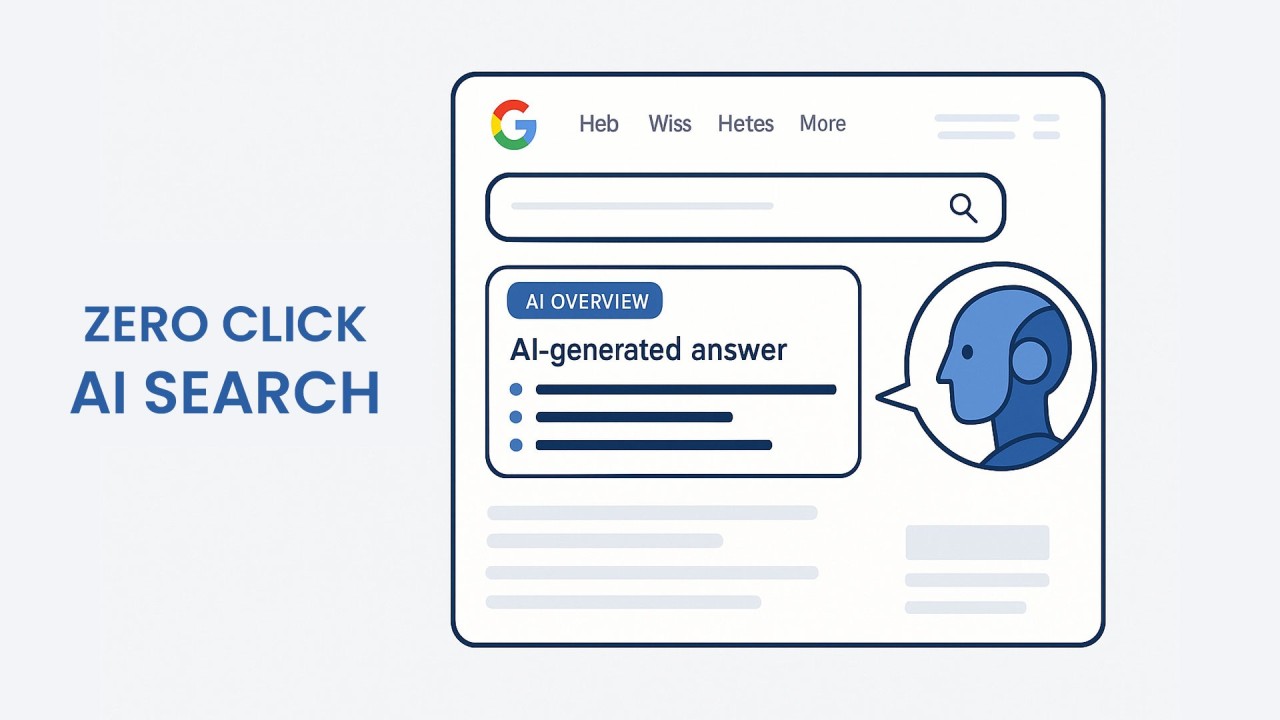
Example of Google’s AI-powered Search Generative Experience (SGE) providing an instant answer at the top of the results page. In this example, the user’s query is answered directly with an AI-generated summary and links, reducing the need to click on any individual website.
Generative AI search results, like Google’s SGE integration, provide users with rich answers, summaries, and even product recommendations right on the results page. For instance, a question about the best tires for a car might yield an AI-crafted summary of options with key facts, meaning the user finds what they need without ever visiting a separate webpage.
Even users who are skeptical of generative AI admit that many of their queries are now answered on the search page itself, without a click. In parallel, standalone AI tools are becoming alternative search engines: platforms like ChatGPT and Perplexity AI have seen surging usage for search-like purposes (ChatGPT’s traffic jumped 44% in late 2024, and Perplexity reached 15 million users). All of this signals a new era where AI is increasingly the first and last stop for finding information.
Impact on the Customer Journey and Marketers’ Visibility
For marketers, the rise of zero-click, AI-driven search poses a serious challenge. When searchers no longer click through to websites, organic traffic and opportunities to engage on your own site dwindle.
Nowhere is this more critical than in high-value, early-stage searches, those generic, non-branded queries like “best budget smartphones” or “how to remove carpet stains”that typically kick off the customer’s discovery process.
Traditionally, a consumer might scan multiple results, visit a few websites, read reviews or blog posts, and gradually move from discovery to consideration of specific brands. Today, that same consumer might instead get a single AI-curated answer or a short list of recommendations without needing to peruse multiple websites.
As a result, brands are losing “share of voice” in these early discovery moments. The AI summary or answer on the SERP becomes the new intermediary between customers and businesses.
It cherry-picks content from across the web and presents a synthesized response. Unless your brand’s information is somehow featured in that AI-generated snippet, the user may never know the source (or notice your brand at all).
In effect, generative AI isn’t just disrupting search traffic, it’s turning the customer journey into an algorithm-driven narrative shaped by the AI. The path from question to answer has fewer touch points where a brand can insert itself, as the AI acts as a gatekeeper, telling the story and recommendations it deems best.
Traditional search vs. AI-mediated search
On the left, users see a list of search results and ads, and brands compete for attention via SEO and paid links. On the right, an AI assistant delivers a curated answer or product suggestions directly.
In the AI-driven scenario, the algorithm itself becomes the new middleman between customers and brands.
In a world of AI-mediated search results, the user’s trust and attention shift from individual websites to the search platform’s AI. For example, instead of reading five different product reviews on five websites, a user might accept the single summary answer the AI provides (which maybe cites a couple of sources in small print).
This streamlined experience is convenient for consumers but can leave brands struggling to stand out. If your content is not among the few sources the AI chooses to highlight, your chance to influence that customer’s decision drops precipitously.
The AI-driven answer becomes the de facto voice that guides the customer’s choice, often overshadowing the voices of individual brands.
Adapting Marketing Strategies for a Zero-Click World
Marketing leaders are now confronted with a pivotal question: How do we remain visible and relevant to consumers who aren’t visiting our website as often via search? Simply doubling down on traditional SEO is necessary but not sufficient. Yes, it’s still important to rank high in search results, but ranking alone won’t guarantee a click if users get what they need from the AI summary. To succeed in this new reality, brands must adjust their strategies on two dimensions.
Marketers must treat AI’s rise not just as a threat to existing traffic, but as an opportunity to evolve strategies. The most successful teams balance efficiency (technical SEO, ensuring content can be processed by AI) on one side, and innovation (experimenting with new content and platforms for AI-driven discovery) on the other.
On one front, companies should shore up the technical fundamentals, making sure their content is accessible, structured, and relevant so that search engine AI’s can easily find and incorporate it.
On the other front, marketers need to experiment boldly with new ways to get their brand and value proposition in front of consumers within those AI-driven experiences (for example, figuring out how to become one of the trusted sources an AI might cite or developing content tailored for Q&A style retrieval).
Balancing these two approaches, the efficient optimization and the innovative exploration, will define which brands maintain visibility as search evolves.
In practical terms, experts and recent research suggest a few key adaptation strategies for this AI-driven, zero-click search era.
Optimize for AI Crawlability and Relevance
Ensure that your content can be effectively crawled and understood by AI algorithms. This means adapting content for semantic search and focusing on clear, high-intent, long-tail keywords that directly answer user questions.
Avoid formats that are opaque to crawlers, or as one report bluntly puts it, “Forget PDFs and gated content; they’re relics in an AI-driven ecosystem.”
In an age where an AI might be reading your page to formulate an answer, structured, clean HTML content with schema markup can be more valuable than fancy interactive widgets that an AI can’t interpret.
The easier you make it for the AI to extract answers from your content, the more likely your information will be featured in zero-click results.
Diversify Content Formats for Generative Search
Don’t limit your SEO strategy to text-based webpages. Generative AI results can draw on various media. For instance, videos, infographics, and interactive toolscan sometimes surface in AI summaries or at least influence search engine algorithms that feed those summaries.
Moreover, users engaging with AI search still appreciate rich media; for example, an AI might cite a cooking video or show an image preview if it adds value. By offering content in multiple formats (articles, videos, Q&As, how-to guides, etc.), you increase the touchpoints where your brand can be picked up by the AI.
Depth and authority are key: a comprehensive piece of content that thoroughly answers a question is more likely to be favored by the AI. As one guideline suggests, prioritize “deep topical authority over shallow keyword tactics.”
In short, become the go-to authority in your niche, across different mediums, so that even if users aren’t clicking your site directly, your information is feeding the answers they see.
Redefine Success Metrics and KPIs
With fewer clicks to measure, marketers need new ways to gauge impact. Instead of focusing solely on click-through rates, start tracking metrics like search impressions, brand mentions, or inclusion rate in AI answers.
For example, if an AI summary cites your brand or content as a source, that’s a form of visibility (even if it didn’t generate a traditional click). Likewise, consider metrics such as how often your pages appear in People Also Ask boxes or other rich results, which are often leveraged by AI.
Internally, you might develop an “AI reach” metric, estimating how many people are seeing your content via AI-driven results. The goal is to “optimize for influence over direct conversions.”
If your content educates the customer at the top of the funnel (even through a third-party AI), it can still influence eventual purchase decisions or brand perception. This requires a mindset shift: the value of search marketing may come as much from indirect exposure and brand authority as from immediate clicks.
Marketing teams are adopting new dashboards and KPIs to measure success in an AI-first search landscape. Instead of just counting clicks and conversions, they’re analyzing impressions, citations, and engagement within AI-driven platforms. This approach helps quantify brand influence even when users don’t visit the site directly.
In addition to the above, companies should keep an eye on emerging search platforms and AI “assistant” partnerships. For instance, if Amazon’s Alexa, Apple’s Siri, or smartphone assistants start integrating more generative AI, ensuring your brand is indexed there will be important. Similarly, paid marketing might shift, if fewer people click organic links, we may see new ad formats where brands can pay for placement within AI answers or chat responses.
Marketers should be prepared to experiment with these new channels early. The key is to remain agile: as algorithms change, continuously test and learn which content gets traction within AI outputs.
Embrace the Change and Innovate
The advent of AI-driven, zero-click search is a fundamental change to the marketing funnel. Brands that stick to the old playbook of just chasing clicks may find themselves invisible in the new landscape. But those that embrace innovation and adapt their strategies boldly can maintain, even expand, their customer reach.
As one industry report noted, successful brands will “embrace innovation and experiment boldly” to remain relevant. This means rethinking how you publish information, how you measure impact, and how you engage customers who might never land on your homepage through search.
Marketing in the AI era is like solving a new puzzle: the pieces (strategies) are different, but if you assemble them correctly, you can still achieve an upward trajectory in growth (represented by the rising graph).
Brands must reassemble their search marketing playbook to fit the AI-shaped puzzle pieces and continue driving results.
Ultimately, the goal for marketers is still the same, to connect with consumers and drive conversions, but the path to get there now runs through algorithmic, AI-driven channels. By proactively optimizing for AI, diversifying content, and shifting success metrics, savvy brands can ensure they remain part of the algorithm’s narrative.
In a world where the first answer might be given by an AI, you want to do everything possible to make sure that answer includes you. Those who pivot quickly and thoughtfully will not only preserve their visibility but can turn the AI revolution to their advantage, writing the next chapter of customer engagement in the process.